
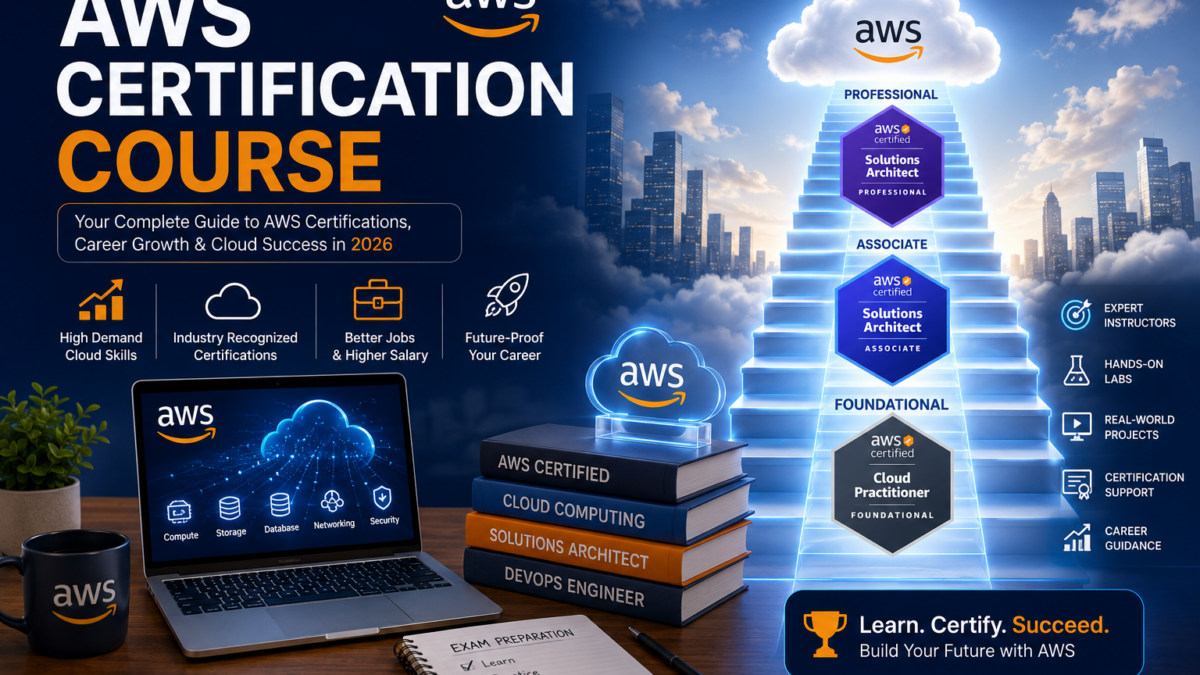

AWS Certification Course: The Complete Guide to Starting Your AWS Career in 2026
AWS Certification Course: The Complete
Guide to Starting Your AWS Career in 2026
Everything you need to know about AWS certifications, certification paths, exam preparation, career opportunities, and how to choose the right AWS certification course to become a cloud professional.
- Introduction — why AWS, why now
- What is an AWS Certification Course
- Why learn AWS in 2026
- AWS certification levels explained
- Best AWS certification for beginners
- Next step after Cloud Practitioner
- Want to become job ready?
- AWS certification roadmap
- Career opportunities after certification
- Skills you’ll learn
- Why choose our AWS Training Institute
- Conclusion
- Frequently asked questions
1Why AWS Certifications Are in High Demand in 2026
Cloud computing has moved from being a competitive advantage to being the default way businesses run their technology. Amazon Web Services remains the largest cloud platform in the world, and as more enterprises, startups, and government bodies migrate workloads to AWS, the demand for skilled, certified professionals continues to climb.
This is exactly why an AWS Certification Course has become one of the most reliable starting points for a career in technology. Certifications give employers a clear, verifiable signal of your skills — and they give you a structured way to build real, job-ready expertise rather than learning in a scattered, unfocused way.
Whether you’re a complete beginner, a working IT professional looking to specialise, or a career-switcher exploring cloud computing certification for the first time, this guide walks through everything you need to know: certification levels, the right starting point, the full AWS certification path, and the practical skills that translate into real job opportunities.
AWS continues to hold the largest share of the global cloud infrastructure market, and certified professionals are consistently sought after across industries — from finance and healthcare to retail and media. Certification has become a practical filter employers use to identify job-ready candidates.
2What Is an AWS Certification Course?
An AWS certification course is a structured training programme designed to prepare learners for an official AWS certification exam, while also building practical, hands-on cloud skills. These courses combine conceptual learning — covering AWS services, architecture, and best practices — with applied exercises, labs, and real-world projects that mirror what cloud professionals do on the job.
Unlike informal or self-directed learning, a well-structured AWS certification training programme follows the official AWS exam blueprint, ensuring learners cover every domain tested in the certification — and nothing critical gets missed.
Benefits of Taking a Structured Course
- Industry recognition: AWS certifications are recognised globally and respected across enterprises of every size.
- Career growth: Certified professionals are frequently prioritised for promotions, new roles, and specialised projects.
- Structured learning path: A course removes the guesswork of what to study, in what order, and to what depth.
- Hands-on confidence: Practical labs build the kind of applied skill that interviews and real projects actually require.
- Validated expertise: A passed exam is a credible, third-party signal of your competence — not just a self-reported skill.
3Why Learn AWS in 2026?
The case for investing in AWS skills has only strengthened heading into 2026. Several converging trends are driving sustained demand for AWS-certified professionals.
Accelerating Cloud Adoption
Organisations across every sector continue shifting workloads to the cloud to reduce infrastructure costs and increase agility. Each migration creates new demand for engineers who understand AWS architecture deeply.
The Rise of AI Workloads
Modern AI and machine learning workloads are overwhelmingly built and trained on cloud infrastructure. AWS’s expanding suite of AI and ML services means cloud professionals are increasingly the ones enabling AI adoption inside their organisations.
Enterprise-Wide Demand
It’s no longer just tech companies hiring cloud engineers. Banks, hospitals, retailers, and manufacturers are all building internal cloud teams — broadening the range of industries where AWS skills are valuable.
Remote and Global Job Opportunities
AWS skills are recognised internationally. A certified AWS professional in India can credibly apply for remote roles with companies in the US, UK, or anywhere else — the certification carries weight regardless of geography.
Long-Term Salary Growth
As professionals progress from foundational to associate, and eventually to professional-level certifications, compensation tends to rise meaningfully — reflecting the increasing scope of responsibility and expertise each level represents.
4AWS Certification Levels Explained
AWS structures its certifications into four levels, each building on the one before it. Understanding this structure is essential before choosing where to start.
| Level | Purpose | Best For |
|---|---|---|
| Foundational | Builds core understanding of cloud concepts, AWS services, security, and pricing | Complete beginners, non-technical professionals, students |
| Associate | Validates hands-on ability to design, deploy, and operate applications on AWS | Learners with foundational knowledge ready to specialise |
| Professional | Validates advanced skills in complex architecture, automation, and operations at scale | Experienced professionals with associate-level certification and real project experience |
| Specialty | Deep expertise in a specific domain — networking, security, machine learning, data analytics | Professionals looking to specialise in a niche, high-value area |
Most learners follow this structure sequentially: starting at the foundational level to build core understanding, advancing to associate-level certifications for hands-on competency, and — over time — pursuing professional or specialty credentials as their career focus sharpens.
5Best AWS Certification for Beginners
For anyone starting from zero, AWS Cloud Practitioner is consistently the recommended entry point — and for good reason. It’s specifically designed for beginners, covering cloud concepts, core AWS services, security fundamentals, and billing — without requiring prior technical experience.
What the Syllabus Covers
- Core cloud computing concepts and deployment models
- Overview of major AWS services across compute, storage, and networking
- AWS shared responsibility model and security fundamentals
- Pricing, billing, and cost management basics
- AWS support plans and the well-architected framework at a high level
Benefits of Starting Here
Cloud Practitioner gives you a vocabulary and conceptual foundation that makes every subsequent certification easier to learn. It also opens doors to entry-level roles like cloud support associate, junior cloud analyst, or technical sales roles where AWS literacy is valued.
If you’re serious about starting the right way, the AWS Cloud Practitioner Course is built specifically for this stage — combining structured lessons with practical context, so you walk away with both the certification and a genuine understanding of how AWS works.
6Next Step After Cloud Practitioner: AWS Solutions Architect
Once you’ve built your foundation, the natural next step is the AWS Solutions Architect Associate certification — widely regarded as one of the most valuable and widely held credentials in the AWS ecosystem.
What You’ll Learn
This certification goes significantly deeper into how real systems are designed and operated on AWS. You’ll study:
- Architecture concepts: Designing resilient, highly available, and cost-optimised systems
- Networking: VPC design, subnets, routing, and secure connectivity between environments
- Storage: Choosing the right storage service and configuration for different workload types
- Security: IAM policies, encryption, and designing systems that meet compliance requirements
- Real-world projects: Practical exercises that mirror the kind of architecture decisions made on the job
This certification is particularly valuable because it shifts your skillset from “understanding AWS” to “designing solutions on AWS” — a meaningful jump in both responsibility and earning potential. The AWS Solutions Architect Associate course is structured specifically to bridge that gap, with guided architecture exercises that build real design intuition.
7Want to Become Job Ready? Add DevOps Skills
Certifications validate your knowledge — but employers increasingly want to see practical, applied skills alongside them. This is where DevOps capabilities make a significant difference in how job-ready you actually are.
The AWS DevOps Job Ready Training Programme is built specifically to close this gap — combining hands-on cloud projects with the practical DevOps tooling that employers consistently look for, so learners graduate with both certifications and a demonstrable project portfolio.
8AWS Certification Roadmap
Here’s the complete AWS certification roadmap most successful learners follow, from first principles to advanced specialisation.
Cloud Practitioner
Build your foundation in cloud concepts, core AWS services, security basics, and billing. The ideal starting point for anyone new to cloud computing.
Solutions Architect Associate
Learn to design resilient, secure, and cost-effective systems on AWS. This is the most widely held associate-level certification and a strong general-purpose credential.
Developer / SysOps Associate
Specialise further based on your interests — Developer Associate for application-focused roles, or SysOps Administrator for operations-focused roles.
DevOps Engineer Professional
Combine development and operations expertise into a professional-level credential focused on automation, CI/CD, and operating systems at scale.
Professional & Specialty Certifications
Pursue Solutions Architect Professional or specialty credentials in security, networking, machine learning, or data analytics — based on where your career is heading.
9Career Opportunities After AWS Certification
AWS certifications open the door to a wide range of AWS jobs across technical specialisations. Here’s a look at common roles and what they typically involve.
10Skills You’ll Learn
Across a complete AWS learning path, here are the core technical skills you’ll build — the same skills referenced throughout real AWS job descriptions.
- EC2 — provisioning and managing virtual compute instances
- IAM — managing identity, access, and permissions securely
- S3 — object storage, lifecycle policies, and data management
- VPC — designing secure, isolated network environments
- RDS — managing relational databases in the cloud
- Lambda — building serverless, event-driven applications
- CloudFormation — infrastructure as code for repeatable deployments
- Monitoring — observability and alerting with CloudWatch
- Security — encryption, compliance, and the shared responsibility model
- Networking — routing, load balancing, and connectivity design
- DevOps — CI/CD pipelines and automated deployment workflows
- Automation — scripting and tooling to eliminate repetitive manual work
11Why Choose Our AWS Training Institute?
Maximyz Cloud’s AWS Training Institute is built around one goal: helping learners build real, job-ready cloud skills — not just pass an exam and move on.
- Industry experts: Courses are taught by practitioners with hands-on AWS experience, not generic instructors reading slides.
- Live training: Real-time, instructor-led sessions with the ability to ask questions and get immediate clarification.
- Hands-on labs: Every course includes practical lab work, so you build real comfort working inside the AWS console and CLI.
- Real projects: Project-based learning that mirrors the kind of work you’ll actually do in a cloud role.
- Career guidance: Support in mapping your certification path to your specific career goals.
- Interview preparation: Practice with scenario-based questions that reflect how AWS interviews are actually structured.
- Certification support: Structured exam preparation and practice assessments built into the course timeline.
12Conclusion — Your AWS Certification Journey Starts Now
AWS certifications remain one of the most reliable investments you can make in a technology career. The path is well-defined, the demand is real, and the skills you build along the way translate directly into job-ready capability — not just credentials on a resume.
If you’re just getting started, begin with AWS Cloud Practitioner to build your foundation. From there, progress to Solutions Architect Associate to develop real architectural skill. And if you want to be genuinely job-ready with the practical tooling employers look for, the DevOps Job Ready Programme is the natural next step.
None of this requires you to figure it out alone. A structured AWS certification course removes the guesswork, keeps you accountable to a clear timeline, and surrounds you with the guidance needed to actually finish what you start.
Ready to start your AWS certification journey?
Explore our full range of AWS courses — from Cloud Practitioner to Solutions Architect to job-ready DevOps training — and find the path that matches your goals.
Explore AWS CoursesNo pressure. No jargon. Just a clear path toward your next AWS certification.
13Frequently Asked Questions
What is an AWS Certification Course?
An AWS certification course is a structured training programme that prepares learners for an official AWS certification exam while building hands-on cloud skills. It typically combines conceptual lessons, practical labs, and project work aligned to the official AWS exam blueprint, helping learners gain both a credential and real, applicable experience.
Which AWS certification is best for beginners?
AWS Cloud Practitioner is the best starting point for beginners. It covers core cloud concepts, foundational AWS services, security basics, and billing — without requiring prior technical experience. It’s designed specifically to introduce non-technical and technical learners alike to the AWS ecosystem before progressing to more advanced certifications.
Is AWS certification worth it?
Yes — AWS certification is widely recognised by employers and consistently associated with stronger job prospects and career progression in cloud-related roles. Beyond the credential itself, the structured preparation builds genuine technical competence that’s directly applicable to real cloud engineering and architecture work.
How long does it take to prepare for AWS certification?
Preparation time varies by certification level and your existing background. Foundational certifications like Cloud Practitioner typically take four to six weeks of consistent study. Associate-level certifications such as Solutions Architect Associate generally take six to twelve weeks, depending on prior experience and how much hands-on lab practice you complete alongside theoretical study.
Which AWS certification has the highest demand?
AWS Solutions Architect Associate is consistently one of the most widely held and requested certifications across job postings, given its broad applicability to architecture and infrastructure roles. AWS DevOps Engineer Professional and Security certifications also see strong, growing demand as organisations prioritise automation and cloud security.
Can I learn AWS without coding?
Yes — foundational and many architecture-focused AWS roles don’t require deep coding skills. AWS Cloud Practitioner and Solutions Architect Associate, for example, focus more on conceptual understanding, configuration, and design rather than software development. However, basic scripting knowledge (such as Python or Bash) becomes increasingly valuable as you move toward DevOps-focused roles.
Which AWS certification should I take first?
For most learners, AWS Cloud Practitioner should be the first certification. It establishes the conceptual foundation that makes every subsequent certification — including Solutions Architect Associate and specialty credentials — significantly easier to study for and understand in context.
What jobs can I get after AWS certification?
Common roles after AWS certification include Cloud Engineer, AWS Solutions Architect, DevOps Engineer, Cloud Consultant, Site Reliability Engineer, and Cloud Administrator. The specific roles available to you depend on which certifications you’ve earned and the practical project experience you’ve built alongside them.
How do I become an AWS Cloud Engineer?
Becoming an AWS Cloud Engineer typically starts with the Cloud Practitioner certification to build foundational knowledge, followed by Solutions Architect Associate to develop hands-on architecture and infrastructure skills. Building real projects — even small personal ones — alongside these certifications, and developing complementary skills like Linux, networking, and basic scripting, significantly strengthens your readiness for the role.
What is the AWS certification roadmap?
The typical AWS certification roadmap progresses from Cloud Practitioner (foundational) to Solutions Architect Associate, followed by a specialisation such as Developer Associate or SysOps Administrator Associate. From there, professionals often advance to professional-level certifications like DevOps Engineer Professional or Solutions Architect Professional, and may pursue specialty certifications in areas like security, networking, or machine learning based on their career focus.
