
Hidden Costs of Not Moving to the Cloud
Hidden Costs of Not Moving to the Cloud
Many businesses focus on the cost of cloud adoption — but the real expense may be delaying it. Discover the hidden operational, security, and growth costs of staying with traditional infrastructure.
- Introduction — the real cost of waiting
- Why businesses delay cloud adoption
- Hidden cost #1 — rising IT maintenance
- Hidden cost #2 — downtime & interruptions
- Hidden cost #3 — limited scalability
- Hidden cost #4 — security risks
- Hidden cost #5 — lost opportunities
- Hidden cost #6 — disaster recovery
- How cloud solves these problems
- Is your business ready for cloud?
- How Maximyz Cloud helps
- Conclusion
- Frequently asked questions
1The Real Cost of Waiting to Move to the Cloud
Most businesses approach cloud adoption by asking one question: how much will migration cost? It’s a reasonable question — but it’s also the wrong starting point. The far more important question is what staying on traditional infrastructure is already costing the business, quietly, every single month.
This is the core of the hidden costs of not moving to the cloud: expenses that don’t show up as a single line item, but accumulate across maintenance contracts, lost productivity, missed opportunities, and risk exposure. Because these costs are distributed rather than itemised, they’re easy to underestimate — and easy to keep deferring.
The common assumption is that staying on-premise is the “safe” or “cheaper” option, while cloud migration is the costly, risky one. For most growing businesses in 2026, that assumption no longer holds. This article breaks down exactly where those hidden costs come from, what they’re really costing your business, and how to evaluate the decision with clear eyes.
Industry surveys consistently show that businesses delaying cloud migration by more than two to three years report meaningfully higher total IT spend than equivalent businesses that migrated earlier — even after accounting for migration costs.
2Why Businesses Delay Cloud Adoption
If hidden costs are real and significant, why do so many businesses still wait? The reasons are understandable — and rarely about the technology itself.
Concerns About Upfront Migration Effort
Migration feels like a large, disruptive project, and many leadership teams would rather avoid the perceived complexity than commit budget and internal resources to it — even when the long-term math favours moving sooner.
Fear of Downtime During the Transition
No business wants to risk an outage during migration, particularly if customer-facing systems are involved. This fear is legitimate, but it’s also manageable with the right phased approach — and it’s frequently weighed against an exaggerated sense of risk.
Lack of In-House Cloud Expertise
Many internal IT teams are skilled at managing existing infrastructure but have limited hands-on cloud experience. Without that expertise, the path forward feels unclear, so the decision gets pushed down the priority list indefinitely.
Comfort With Existing Systems
“It works” is a powerful argument for inertia. Existing systems are familiar, even if they’re inefficient — and familiarity often outweighs a vague, unquantified sense that something better exists.
3Hidden Cost #1 — Rising IT Maintenance Costs
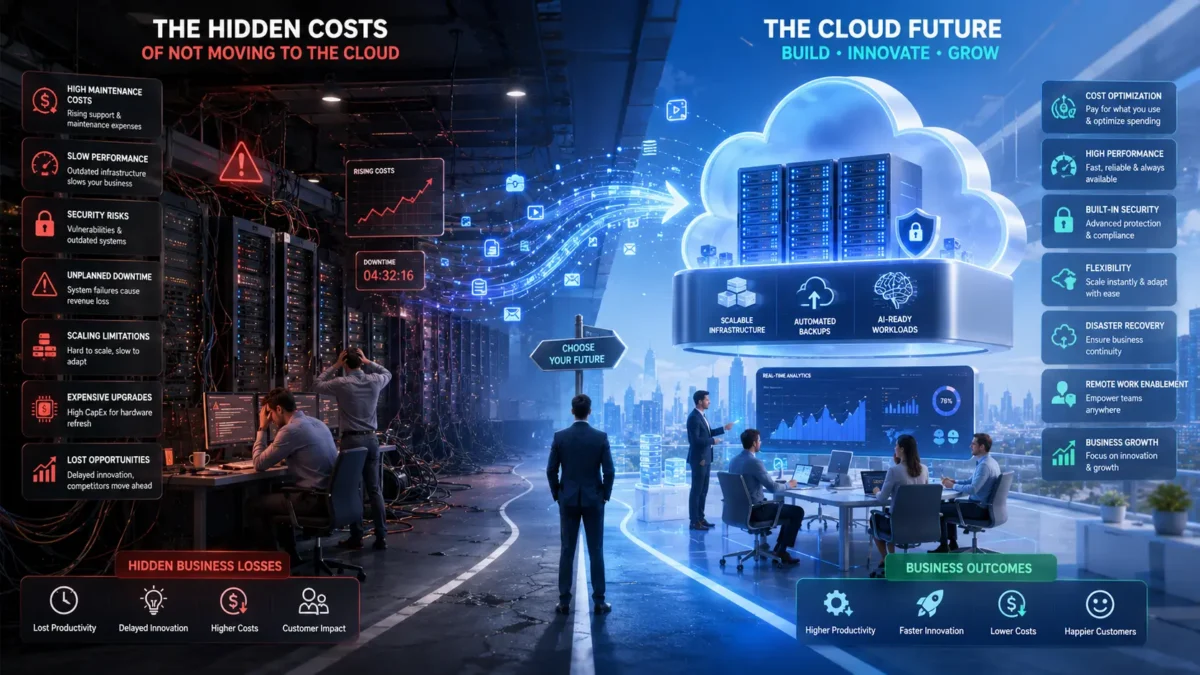
On-premises infrastructure carries a continuous maintenance burden that grows more expensive every year. Hardware doesn’t last forever, and the cost of keeping it running climbs steadily as it ages.
Servers, storage arrays, and networking equipment typically need replacement every three to five years. Each cycle requires significant capital expenditure, plus the labour cost of procurement, installation, and configuration.
Vendor support contracts, extended warranties, and specialist maintenance staff add a recurring cost layer that scales with the size and age of your infrastructure — often without a corresponding increase in performance.
Every hour your IT team spends patching, troubleshooting, or replacing failing hardware is an hour not spent on initiatives that actually move the business forward. This opportunity cost rarely appears on a budget sheet, but it’s very real.
Cloud infrastructure shifts these costs from unpredictable capital expenditure to predictable operational spend — with the underlying hardware maintained entirely by the provider.
4Hidden Cost #2 — Downtime and Business Interruptions
Downtime is one of the most direct and measurable hidden costs of staying on legacy infrastructure. Every outage carries a compounding cost: lost productivity, lost revenue, and lost customer trust.
Productivity Loss
When core systems go down, employees can’t access the tools they need to do their jobs. Even a short outage across a mid-sized organisation can translate into hundreds of lost work-hours.
Customer Impact
For customer-facing applications, downtime is visible immediately. Customers don’t distinguish between “planned maintenance” and “system failure” — they simply experience a service that didn’t work, and that experience shapes their loyalty.
On-premises systems typically lack the built-in redundancy that cloud platforms offer by default. A single point of failure — a power outage, a failed disk, a network issue — can take critical systems offline for hours, while cloud environments are designed with automatic failover to prevent exactly this scenario.
5Hidden Cost #3 — Limited Scalability
Business growth rarely happens on a predictable schedule — and infrastructure that can’t keep pace becomes a direct constraint on how fast a business can move.
Consider a seasonal retailer preparing for a major sales event, or a SaaS company onboarding a large new enterprise client. In both cases, demand can spike well beyond normal levels, sometimes with very little notice. On-premises infrastructure requires lead time — procurement, installation, configuration — that simply doesn’t exist when an opportunity needs to be captured immediately.
This isn’t just a technical limitation. It’s a cloud infrastructure constraint that quietly shapes which business opportunities are realistically achievable and which ones get turned down because “the systems can’t handle it.”
6Hidden Cost #4 — Security Risks
Security is one of the least visible — and most expensive — hidden costs of delaying cloud adoption. Legacy systems accumulate risk quietly, often without leadership realising the extent of the exposure until something goes wrong.
Outdated Systems and Patch Management
Legacy infrastructure often runs on older operating systems and software versions that no longer receive regular security updates. Keeping every system fully patched across an ageing environment is resource-intensive, and gaps inevitably appear.
Ransomware and Cyberattack Exposure
Outdated systems are disproportionately targeted by ransomware and other attacks, simply because known vulnerabilities remain unpatched for longer. The cost of a successful breach — recovery, downtime, reputational damage, potential ransom — can far exceed the cost of migration many times over.
Compliance Gaps
Regulatory requirements around data protection continue to tighten across industries. Maintaining compliance on self-managed infrastructure requires continuous internal investment, while major cloud providers build compliance certifications directly into their platforms.
Cloud providers invest billions annually in security infrastructure that few individual businesses could replicate independently — including continuous monitoring, automated threat detection, and built-in compliance frameworks for standards like ISO 27001, SOC 2, and GDPR.
7Hidden Cost #5 — Lost Business Opportunities
Perhaps the least visible hidden cost is the one measured in opportunities never pursued. Infrastructure that can’t move quickly limits how quickly the business itself can move.
Slower Innovation Cycles
Development teams working with constrained on-premises environments typically face longer setup times for new projects, testing environments, and experiments — slowing the pace at which new ideas reach customers.
Delayed Product and Feature Deployments
Without cloud-native CI/CD pipelines and elastic testing environments, deployment cycles stretch from days to weeks. In competitive markets, that lag can mean a competitor reaches the market first.
Inability to Adopt AI and Modern Tooling
Most modern AI, machine learning, and advanced analytics tools are built cloud-first. Businesses on legacy infrastructure often find themselves structurally excluded from adopting these capabilities — not because the tools don’t exist, but because their infrastructure can’t support them.
8Hidden Cost #6 — Higher Disaster Recovery Costs
Disaster recovery is where the gap between traditional infrastructure and cloud infrastructure becomes most stark — in both cost and capability.
| Factor | Traditional Infrastructure | Cloud Infrastructure |
|---|---|---|
| Backup Infrastructure | Requires separate physical backup site and hardware | Built-in, automated, geo-redundant backups |
| Recovery Time | Hours to days, depending on backup method | Minutes, with automated failover |
| Upfront Cost | High — duplicate hardware and facility costs | Low — pay-as-you-go, no duplicate hardware |
| Testing Disaster Recovery Plans | Complex, costly, often skipped or infrequent | Simple to simulate and test regularly |
| Geographic Redundancy | Limited by physical site locations | Available across multiple regions by default |
The gap here isn’t marginal. Businesses relying on traditional disaster recovery setups often discover — only after an incident — that their recovery time and data loss exposure were significantly worse than they assumed.
9How Cloud Solves These Problems
Each of the hidden costs outlined above has a direct, well-established counterpart in cloud infrastructure. Here’s how moving to the cloud addresses them systematically.
10Is Your Business Ready for Cloud?
If several of the following statements describe your business today, the hidden costs outlined in this article are likely already affecting your bottom line.
- Rising IT maintenance and hardware costs year over year
- Frequent downtime, outages, or performance slowdowns
- A growing remote or hybrid workforce straining existing systems
- Active growth plans, new markets, or seasonal demand spikes
- Ongoing concerns about security, patching, or compliance
- Disaster recovery plans that haven’t been tested recently — or at all
None of these signals require an immediate, all-at-once migration. But each one is a clear indication that the cost of staying as-is is already higher than most leadership teams realise.
11How Maximyz Cloud Helps
Maximyz Cloud provides business cloud solutions designed to help organisations move past these hidden costs with a clear, low-risk migration path — not a disruptive overhaul.
- Migration planning: A thorough assessment of your current environment, identifying the right migration approach for each workload before any move begins.
- AWS expertise: Certified cloud migration services covering compute, storage, networking, and database migration with proven, low-risk methodologies.
- Azure capabilities: Enterprise-grade migration support for organisations needing Microsoft ecosystem continuity and built-in cloud cost optimization from day one.
- Google Cloud expertise: Modernisation support for businesses building on cloud infrastructure for analytics, AI, and containerised workloads.
- Post-migration optimisation: Ongoing right-sizing, cost governance, and performance tuning to ensure your cloud environment delivers real, measurable ROI.
- Managed services: Continuous monitoring, security management, and support — so your internal team isn’t left managing complexity alone.
12Conclusion — The Biggest Cloud Expense Isn’t Migration
Across maintenance, downtime, scalability, security, lost opportunities, and disaster recovery, the pattern is consistent: the hidden costs of not moving to the cloud are real, they compound over time, and they are almost always larger than the cost of migration itself.
The biggest expense most businesses face isn’t the investment required to move to the cloud. It’s the accumulated cost of waiting — paid quietly, every month, in maintenance bills, lost productivity, missed opportunities, and unmanaged risk.
If any of the signals in this guide sound familiar, the right next step isn’t a major commitment — it’s a clear-eyed conversation about where your business actually stands. Talk to our cloud experts for a straightforward assessment, with no pressure and no obligation.
Stop paying the hidden cost of waiting
Talk to a Maximyz Cloud specialist about what staying on-premise is really costing your business — and what a low-risk migration path could look like.
Talk to Maximyz CloudNo pressure. No jargon. Just a clear conversation about what’s right for your business.
13Frequently Asked Questions
What are the hidden costs of not moving to the cloud?
The hidden costs include rising IT maintenance and hardware expenses, lost productivity and revenue from downtime, limited scalability that constrains growth, increased security and compliance risk from outdated systems, missed business opportunities due to slower innovation, and significantly higher disaster recovery costs compared to cloud-native alternatives. These costs accumulate gradually and rarely appear as a single line item, which is why they’re frequently underestimated.
Is cloud migration expensive?
Cloud migration involves upfront investment in planning, execution, and potentially re-architecting certain applications. However, when compared against the ongoing costs of maintaining legacy infrastructure — hardware refreshes, support contracts, downtime, and security risk — most businesses find that migration pays for itself within the first one to two years, with cost savings continuing to compound after that point.
How does cloud reduce business costs?
Cloud reduces costs by replacing large capital expenditure on hardware with predictable, usage-based operational spending. It also reduces the staff time spent on routine maintenance, lowers the financial risk of downtime through built-in redundancy, and reduces security and compliance overhead through provider-managed infrastructure. Many cloud platforms also include cost optimisation tools that automatically right-size resources to avoid overspending.
When should businesses migrate to the cloud?
Businesses should seriously evaluate cloud migration when they notice rising IT maintenance costs, recurring downtime, scalability constraints during growth periods, increasing security or compliance concerns, or a growing remote workforce that strains existing systems. Waiting for a single “perfect moment” is rarely productive — most organisations benefit from starting the conversation as soon as two or more of these signals appear.
How can cloud improve business growth?
Cloud infrastructure removes the capacity constraints that often limit how quickly a business can expand — whether that means entering new markets, supporting seasonal demand spikes, or onboarding large new customers. It also enables faster product development cycles and gives businesses access to modern AI and analytics tools that are typically built cloud-first, allowing growth-stage companies to innovate and scale without being held back by infrastructure limitations.
