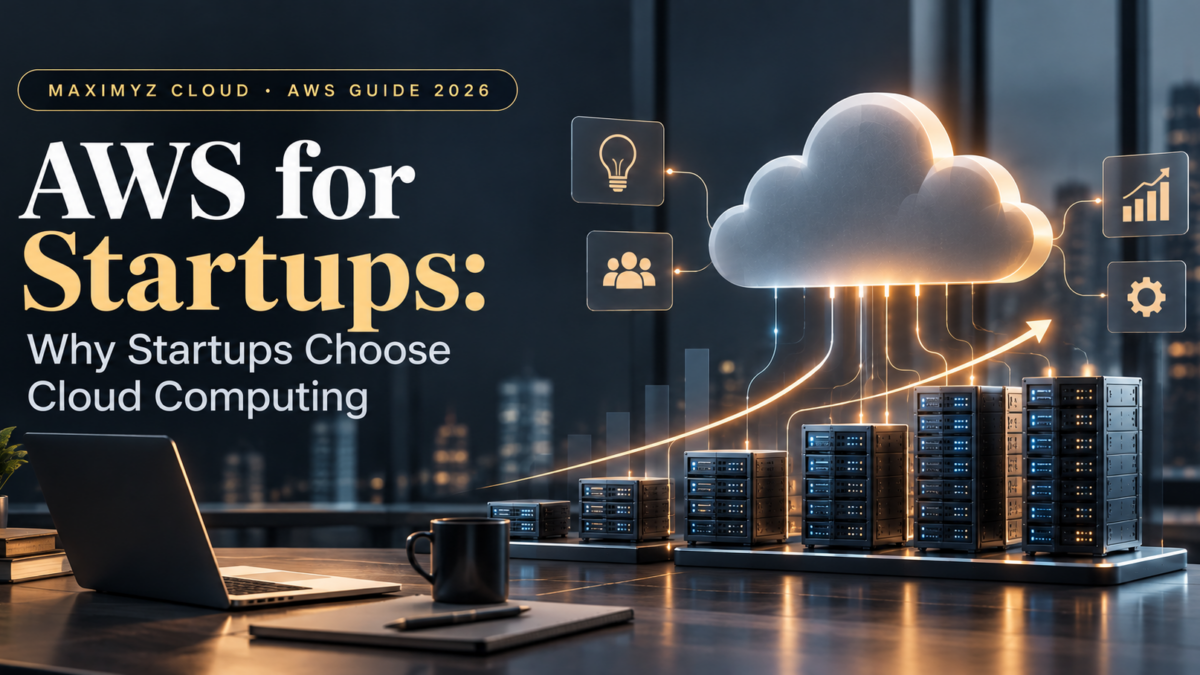

AWS for Startups: Why Startups Choose Cloud Computing
Introduction
Startups often have to build products quickly while working with limited budgets, small teams, and uncertain growth patterns. A new application may have only a few users initially and then experience a sharp increase in traffic after a successful launch, marketing campaign, or product update.
This makes infrastructure planning difficult. Buying and maintaining physical servers before demand is known can create unnecessary capacity, while underestimating requirements can create technical limitations later.
Cloud computing gives startups another approach. Instead of building a large physical infrastructure environment upfront, businesses can provision computing, storage, databases, networking, and other services as their requirements develop. AWS provides a broad collection of these capabilities, allowing startups to build an environment around their specific application and workload.
Why Cloud Computing Matters for Startups
Cloud infrastructure can be particularly useful when a startup’s requirements are changing rapidly. Resources can be provisioned and modified without waiting for physical hardware to be purchased, installed, and maintained.
This flexibility can support several stages of a startup’s journey. A company can begin with a relatively simple architecture, test its product, and introduce additional infrastructure as users and workloads increase.
However, cloud computing is not automatically cheaper or simpler than every alternative. Startups still need to manage architecture, security, monitoring, performance, and spending carefully.
Why Startups Consider AWS
Flexible Infrastructure
AWS provides different options for compute, storage, databases, networking, and application services. Amazon EC2, for example, provides resizable computing capacity, allowing businesses to change the number or size of virtual servers as requirements evolve.
Scalability
A startup may need very different levels of infrastructure at different stages. AWS services such as EC2 Auto Scaling can adjust EC2 capacity according to configured scaling policies, while Elastic Load Balancing can distribute incoming application traffic across available instances.
Broad Range of Services
Startups can choose from services for computing, databases, object storage, serverless applications, content delivery, monitoring, identity management, and other workloads. This allows different parts of a product to use services appropriate to their specific requirements.
Faster Deployment and Global Infrastructure
Cloud resources can be provisioned without setting up physical servers. AWS also operates infrastructure across multiple Regions and Availability Zones, giving startups options when designing applications for geographic distribution and availability.
Security and Access Management
AWS IAM helps control access to AWS resources by defining permissions through identities, roles, and policies. This can help startups establish structured access controls as their teams and cloud environments become larger.
Usage-Based Pricing Options
AWS uses a pay-as-you-go approach for most cloud services, meaning charges generally depend on the services and resources a customer uses. AWS also provides other purchasing and pricing options for certain workloads.
AWS Services Useful for Startups
Amazon EC2
EC2 provides virtual servers that can run websites, APIs, application backends, and other workloads. Startups can select computing capacity based on current requirements and adjust it later.
Amazon S3
Amazon S3 provides object storage for assets such as images, videos, application files, backups, and other data. Its different storage classes can accommodate different access patterns.
Amazon RDS
Amazon RDS is a managed relational database service that handles common administration tasks such as provisioning, backups, patching, and monitoring. This can reduce some database-management work for startup teams.
AWS Lambda
AWS Lambda allows startups to run code without provisioning or managing servers. It can suit event-driven workloads, APIs, scheduled processing, and background tasks when a serverless architecture fits the application.
Amazon CloudFront
CloudFront is a content delivery network that distributes content through AWS edge locations. It can be useful for delivering website assets and other content efficiently to users.
Amazon CloudWatch
CloudWatch provides monitoring capabilities including metrics, logs, dashboards, and alarms for AWS resources and applications. This visibility can help startup teams understand resource usage and application behavior
AWS IAM
IAM provides access control for AWS resources, allowing businesses to define which users, roles, and workloads can perform particular actions.
Scaling as the Startup Grows
Consider a startup launching a SaaS application. Initially, only a small number of customers use the platform. A successful product launch then brings a sudden increase in users.
With an architecture using Elastic Load Balancing and EC2 Auto Scaling, incoming requests can be distributed across EC2 instances while the Auto Scaling group adjusts capacity according to configured policies.
The important point is that scaling should involve the entire application. Databases, storage, networking, APIs, and third-party integrations can also become bottlenecks. Startups should therefore test how their architecture behaves as demand increases.
Managing Cloud Costs
Cloud costs can become difficult to control when resources grow faster than expected. Startups should make cost management part of normal operations.
Useful practices include:
- Reviewing resource usage regularly
- Removing unused development and test resources
- Choosing appropriately sized compute resources
- Monitoring service usage and monthly spending
- Reviewing the architecture as workloads change
AWS provides services such as Cost Explorer and AWS Budgets to help organizations analyze costs, usage, and budget thresholds. The right cost strategy depends on the application’s architecture and workload rather than simply choosing the lowest-priced option.
Security and Reliability
Security should be considered from the beginning, not after a startup has already grown. Access should be limited according to actual responsibilities, important data should have appropriate backup and recovery processes, and infrastructure should be monitored.
AWS provides capabilities such as IAM for access control and CloudWatch for monitoring. Managed services such as RDS can also handle certain operational tasks, although startups remain responsible for configuring and operating their environments correctly.
Key Benefits of AWS for Startups
For suitable workloads, AWS can provide startups with:
- Scalability as demand changes
- Flexibility in choosing infrastructure and services
- Faster development and deployment of cloud-based workloads
- Access to managed services that can reduce some operational tasks
- Global infrastructure options for geographic requirements
- Tools for resource and cost management
These are capabilities rather than guarantees. Their value depends on how the startup designs, configures, and operates its environment.
Things Startups Should Consider Before Choosing AWS
AWS may be appropriate for one startup but unnecessary for another. Before selecting a cloud architecture, teams should consider:
- Expected workload: Current and anticipated compute, storage, database, and traffic needs
- Budget: Whether projected cloud spending fits the business plan
- Technical expertise: Whether the team can manage the chosen environment
- Required services: Which AWS services are actually necessary
- Security requirements: Access control, data protection, backup, and compliance needs
- Long-term infrastructure needs: Whether the architecture can evolve with the product
A clear assessment can help startups avoid both overengineering and infrastructure constraints.
Conclusion
Cloud computing can give startups a flexible way to build and evolve their technology infrastructure as their products develop. AWS provides services across computing, storage, databases, serverless applications, monitoring, content delivery, and access management, allowing startups to assemble infrastructure around their requirements.
AWS is not automatically the right choice for every company. The most appropriate platform depends on a startup’s workload, budget, technical capabilities, security requirements, and growth plans.
For startups evaluating AWS infrastructure, migration, or cloud optimization, Maximyz Cloud Tech provides cloud consulting and technology solutions designed around business requirements.
